The Most Common Impersonation Scams — and How to Spot Them
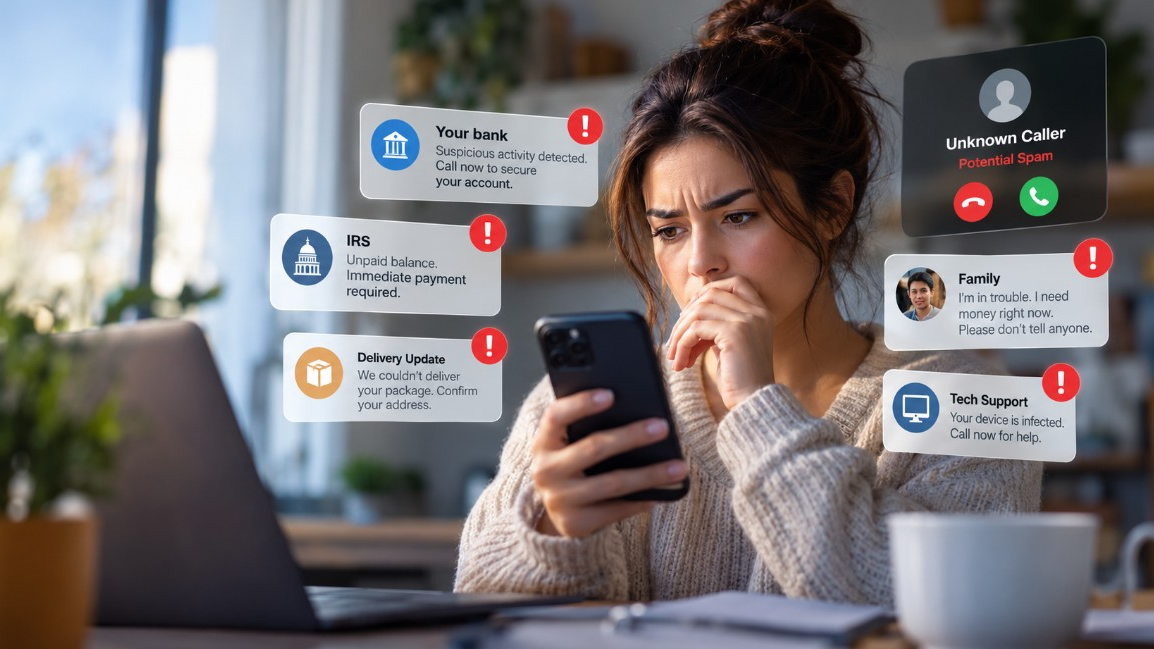
Impersonation is the most successful category of consumer fraud in America, and it has been for five years running.
Americans reported $3.5 billion in losses to imposter scams in 2025, and nearly one in three fraud reports to the FTC fell into this category. Losses have roughly tripled since 2020.
It works because it does not require breaking anything. It requires only that you believe, for about thirty seconds, that you are talking to someone you already trust.
The specific stories change constantly. The structure never does.
The structure barely changes
Almost every impersonation scam has four parts.
1. A trusted identity. A bank, a government agency, a company you use, a family member.
2. A problem that needs your attention. Suspicious activity, an unpaid fine, a delivery issue, an emergency.
3. Urgency. It must be handled now, today, before something bad happens.
4. An action only you can take. Move money, share a code, confirm details, pay a fee.
If a message has all four, it is a scam, regardless of how convincing the details are. Real organizations rarely combine urgency with an irreversible action.
The ten most common impersonation scams
1. Bank impersonation
The costliest single form of business impersonation. A text or call about suspicious activity, then a "fraud officer" who helps you secure your account by moving money to a "safe account", or asks you to confirm a code.
The tell: your bank will never ask you to move money to protect it, and no bank asks you to read back a one-time code. There is no such thing as a safe account.
What to do: hang up and call the number on the back of your card. Use a different phone if you can, since call-transfer tricks exist.
2. Government impersonation
$920 million in reported losses in 2025, up from $789 million the year before. The IRS, the Social Security Administration, Medicare, immigration authorities, or a local court, claiming an unpaid debt, a suspended number, or a warrant.
The tell: federal agencies initiate contact by mail, do not demand immediate payment by phone, and never accept gift cards, wire transfers, or cryptocurrency.
3. Toll and traffic fine texts
One of the highest-volume campaigns in recent years. A small unpaid toll, a late fee threatened, a payment link.
The tell: the amount is deliberately small enough to pay without thinking, and tolling authorities do not collect by text link. Check your account with the tolling agency directly.
4. Delivery company impersonation
A parcel could not be delivered; confirm your address or pay a small redelivery fee.
The tell: carriers do not charge redelivery fees by text. Track the parcel with the number from your original order confirmation, never a link in the message.
5. Tech support
A pop-up, call, or email claiming your device is infected, usually naming a well-known software company. It leads to remote access software, then to "refunds" that are engineered to look like an overpayment you must return.
The tell: no legitimate technology company monitors your personal device and calls you about it. Never grant remote access to someone who contacted you.
6. Utility shut-off threats
A call claiming your power or water will be disconnected within the hour unless you pay immediately, often targeting small businesses during working hours.
The tell: utilities send written notice and follow a regulated disconnection process. They do not take gift cards.
7. Family emergency and AI voice scams
A relative, usually described as in an accident, arrested, or stranded, needing money urgently and asking you not to tell anyone. Voice cloning has made these considerably more convincing, and AI-related complaints accounted for more than $893 million in reported losses in the FBI's 2025 dataset.
The tell: the request for secrecy, and the urgency. Hang up and call the person back on the number you already have. Agree a family code word.
8. Employer and job offer scams
Well-paid remote work offered by text or on a messaging app, often "product reviewing" or task-based work. It ends with you depositing your own money to unlock commissions, or being sent a fake check and asked to forward part of it.
The tell: you never pay to work, and a real employer does not recruit by unsolicited text.
9. Company and subscription renewal invoices
An email confirming an expensive renewal you did not order, with a phone number to cancel. Calling connects you to the scammer, who asks for remote access or card details to process the "refund".
The tell: the email contains a phone number instead of an account link. Check the subscription in your own account or app store instead.
10. Fake settlement and refund notices
A notice that copies a real class action, data breach or government refund notice, and asks for your bank login to send the money.
The tell: no settlement needs your bank login to pay you, and a real one names a case and a court you can look up yourself. This one is worth knowing precisely because the underlying thing is real — genuine settlements do pay people, which is what makes the imitation effective.
Protect Your Money With Our Free Newsletter
Three things that are always a scam
Worth committing to memory, because they hold without exception.
Anyone asking you to read back a verification code. That code exists to prove it is you. Sharing it proves it is them. No legitimate organization asks.
Anyone asking for payment in gift cards, wire transfer, or cryptocurrency. No government agency, utility, or real business requires these. They are demanded because they cannot be reversed.
Anyone telling you to move money to keep it safe. Banks, police, and government agencies do not do this. It is the defining move of the bank impersonation scam.
Why these keep working
Not because victims are careless. Because the attacks are professionally run, well rehearsed, and specifically designed to short-circuit judgment.
Urgency is the mechanism. Under time pressure people verify less and comply more, and every one of these scams manufactures it deliberately. The scripts are refined across thousands of attempts.
Age is not the protection people assume. Younger adults report losing money to fraud more often than older adults, largely because more of their contact happens online. Older adults lose more per incident. Nobody is outside the target set.
If you have already engaged
Shared a code or password: change the password immediately, sign out all sessions, and contact the provider.
Gave card or bank details: call your bank on the number on your card and have the details canceled.
Granted remote access: disconnect the device from the internet, have it checked, and change passwords from a different device.
Sent money: how you paid decides your odds, and the deadlines are short. See what to do if you paid a scammer.
Report it to the FTC at reportfraud.ftc.gov and, for anything online, to the FBI at ic3.gov. Forward scam texts to 7726.
What Chimo does
Chimo works on the recovery side: class action settlements, refunds, and consumer claims against companies whose own conduct or security failures cost people money.
If your data was exposed in a company's breach — which is where a great deal of impersonation material originates — that is frequently the subject of a settlement, and those settlements pay.
- What is the most common scam in the US?
- Imposter scams, which have led FTC fraud reports for five consecutive years and accounted for $3.5 billion in reported losses in 2025. Nearly one in three fraud reports involves someone pretending to be a bank, a government agency, a business, or a relative.
- How can I tell if a call from my bank is real?
- Hang up and call the number on the back of your card, ideally from a different phone. Your bank will never ask you to move money to a safe account or read back a one-time code, so either request identifies the call as a scam regardless of what the caller ID shows.
- Do government agencies ever call or text about money you owe?
- Federal agencies initiate contact by mail, not by phone or text, and they never demand immediate payment or accept gift cards, wire transfers, or cryptocurrency. Government impersonation caused $920 million in reported losses in 2025.
- What is an AI voice scam?
- A family emergency scam using cloned audio of a relative's voice, asking urgently for money and usually for secrecy. Hang up and call the person back on a number you already have, and agree a family code word in advance.
- Why do scammers ask for gift cards?
- Because gift card payments are near-untraceable and effectively irreversible once the codes are used, usually within minutes. No legitimate business or agency requires payment in gift cards, so the request itself is conclusive.
- Are younger people safer from scams than older people?
- No. Younger adults actually report losing money to fraud more often, since more of their contact with strangers happens online, while older adults lose more per incident. Neither group is outside the target set.
Related reading
For the specific case of scam texts, see how to tell if a text message is a scam. If money has already left your account, what to do if you paid a scammer is organized by payment method. For the national data behind these patterns, read the state of consumer scams in America and how much money Americans lose to scams each year.

