How Long Do Class Action Settlements Take to Pay Out?

Filing a claim is the fast part. Getting paid takes months, and sometimes years.
For most consumer settlements, expect six to eighteen months between the claim deadline and the money arriving. If someone appeals the settlement, add a year or more.
That is not a sign anything has gone wrong. It is how the process is built.
The timeline, stage by stage
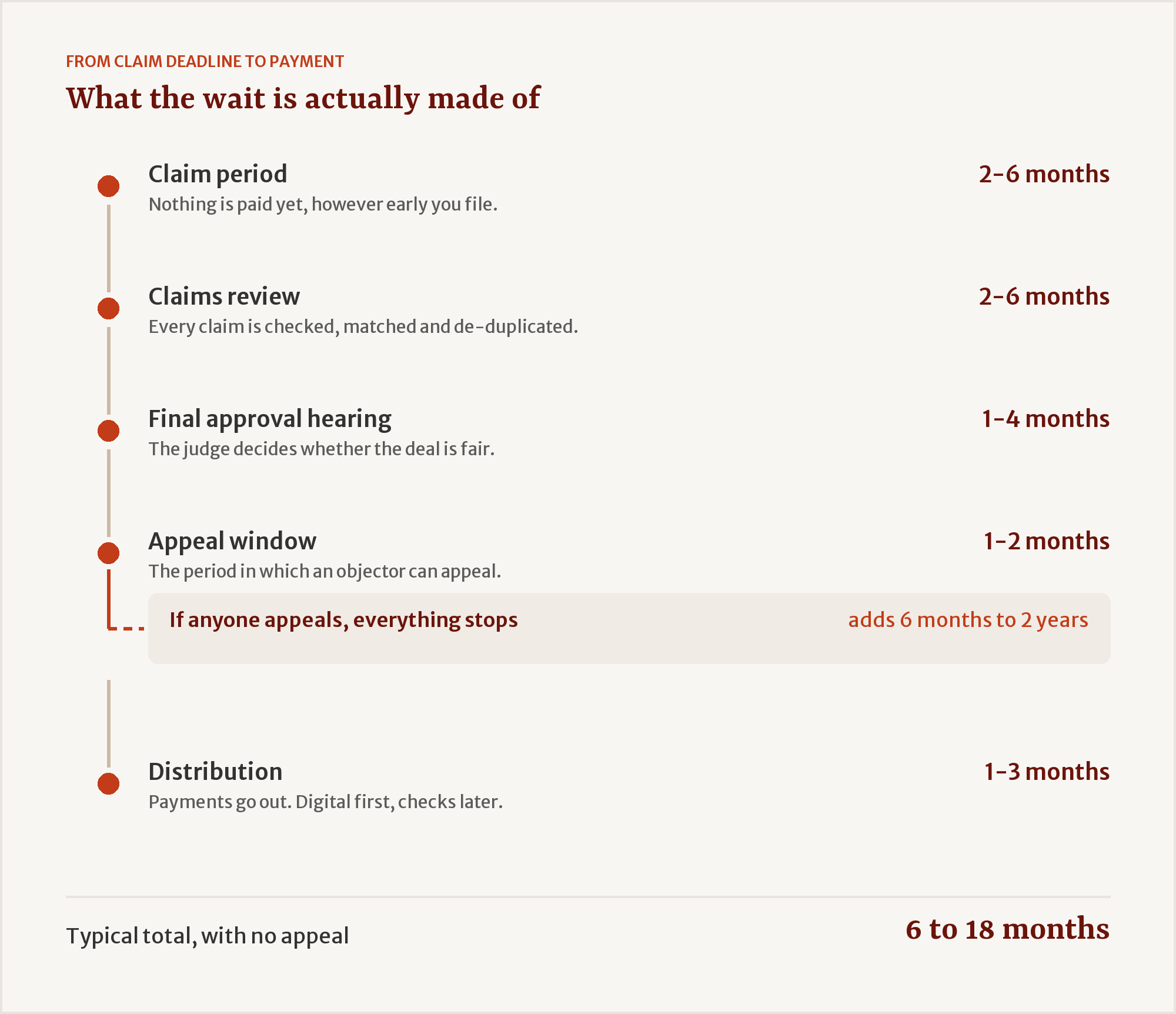
The claim period
Runs from preliminary approval to the claim deadline, usually between two and six months. Nothing is paid during this window, however early you file. Filing on day one and filing on the last day generally produce the same result, so the only thing that matters is not missing it.
Claims review
The administrator validates every claim: checking eligibility, removing duplicates, matching against company records, and following up on incomplete submissions. On a large settlement this can mean processing millions of claims.
This stage also determines the final per-person amount when a settlement pays pro rata — meaning the fund is split between everyone who filed a valid claim, so the more people who claim, the smaller each share.
Final approval
The judge holds a hearing and decides whether the settlement is fair, reasonable, and adequate. Class members can object or, occasionally, attend and speak.
Approval is usually granted, but it can come with changes, and the hearing itself is often rescheduled.
The appeal window, and appeals
After approval there is a window in which anyone who objected can appeal. If nobody does, the settlement becomes final and money can move.
If someone does appeal, everything stops. Not the payments to some people, all of them. An appeal commonly adds six months to two years.
This is the single largest source of delay, and it is entirely outside your control.
Distribution
Once the settlement is final, the administrator issues payments, typically over one to three months. Digital payments usually go out ahead of mailed checks, though that is a tendency rather than a rule.
Why settlements get delayed
Appeals. By far the biggest factor, and the one worth understanding, because it is the only delay that can double the wait.
Only someone who formally objected to the settlement can appeal it, and what they are appealing is the judge's decision to approve the deal — not their own payment. The usual grounds are that the fund is too small, that the lawyers are taking too much of it, or that the class was defined unfairly. Some appeals are filed in good faith by class members who genuinely think the deal is bad for them. Others come from professional objectors, who file across many settlements and withdraw in exchange for a payment. Courts have pushed back on that practice by requiring objectors to disclose what they receive for dropping an appeal.
The effect is the same either way: an appeal suspends distribution for the whole class, not just for the person who filed it. Most settlements are never appealed and reach distribution without one. But when an appeal is filed, it commonly adds six months to two years, and there is nothing a claimant can do to speed it up.
Claims volume. An unexpectedly large response slows validation and, in a pro rata settlement, reduces individual payments.
Fraudulent claim waves. Some settlements attract organized mass filing of fake claims. Administrators then apply extra verification to everyone, which delays legitimate claimants.
Administrative problems. Address errors, uncashed checks, and payment processor issues all add time.
Related litigation. Where a settlement is entangled with other cases or a bankruptcy, distribution can wait on those.
Check vs digital payment
Most settlements now offer a choice, and the right answer is less obvious than it looks.
Digital payments — PayPal, Venmo, Zelle, or direct deposit — usually arrive first, often weeks ahead of checks, and cannot go missing in the mail. That is the general case rather than a guarantee. Administrators do run into trouble with a payment processor and reissue days or weeks later. Digital payments also land at an email address or phone number, so if you have lost access to the inbox you claimed with, or you are locked out of the account, the money can sit undelivered while you sort it out.
Prepaid and virtual cards are the one option worth avoiding. They arrive quickly, but spending a card down to zero is genuinely awkward. Most merchants cannot split a payment between a card and another method, so a few dollars tend to strand on the balance, and there is usually no way to move that remainder into a bank account. A $40 payment that leaves $3.18 behind is a $36.82 payment.
Paper checks are slower and come with a deadline: settlement checks typically become void after 60 to 180 days, and the date is printed on the check. What they have going for them is that once you deposit one, the money is fully yours from day one, sitting in your own account with nothing left behind. If the choice is between a prepaid card and a check, take the check.
Deposit a settlement check promptly. Uncashed checks are a large and entirely avoidable source of unclaimed settlement money. If enough go uncashed, the remainder is usually either shared out again among the people who did claim, or given to a court-approved charity under what is called a cy pres provision — the legal term for money that cannot practically be returned to the class being put toward a related public purpose instead. Either way, you get nothing.
What to do if your payment never arrives
1. Check the expected timeline first. Most settlements publish a payment schedule. If the distribution date has not passed, nothing is wrong.
2. Find your claim number. It is in the confirmation email you received when you filed.
3. Contact the settlement administrator. They have a dedicated phone number and email for the case, and they can tell you the status of your specific claim: approved, rejected, pending, or paid.
4. Ask specifically whether a payment was issued and where it went. If a check was mailed to an old address, they can usually reissue it.
5. If a check has expired, ask about reissue. Many administrators will reissue within a set window, though not indefinitely.
6. Confirm your claim was not rejected. Rejections do happen and notice of them is sometimes missed. If it was rejected, ask why and whether there is an appeal or cure process, which there often is.
How long to wait before chasing a payment
If you file a claim today, a reasonable expectation is that you hear nothing for several months, then either a payment appears or you have to chase it once.
The people who actually get paid are the ones who keep the confirmation email and follow up once if the money does not turn up. That single habit is worth more than any amount of checking in the first few months.
What Chimo does
Chimo tracks the settlements you have claimed through us and the stage each one has reached, so the six-to-eighteen-month wait does not depend on you remembering a case name from last spring.
Recover More Money With Our Free Newsletter
- How long after the claim deadline do class action settlements pay?
- Six to eighteen months is the normal range for consumer settlements, covering claims review, the final approval hearing, and the appeal window. An appeal can extend that by a further six months to two years.
- Does filing early get me paid sooner?
- No. Payments are issued after the settlement becomes final, not in the order claims arrive, so an early filing and a last-day filing are usually paid at the same time. Filing early only protects you against forgetting the deadline.
- Why did my settlement payment come out smaller than the amount advertised?
- Many settlements pay pro rata, meaning the fund is divided among everyone who filed a valid claim, so a higher-than-expected response reduces each share. Attorneys' fees and administration costs also come out of the fund before distribution.
- What happens if I lose or never cash a settlement check?
- Contact the administrator with your claim number and ask for a reissue, which many will do within a set window after the void date. Money from uncashed checks is often redistributed to other claimants or paid to a court-approved charity, so an uncashed check is usually money lost.
- Can a class action settlement deadline be extended?
- Occasionally, and it is normally the court that extends the claim deadline rather than the administrator, often when notice reached fewer people than expected. It is not something to count on, so treat the published deadline as firm.
- How do I check the status of a claim I already filed?
- Use the claim number from your confirmation email and contact the settlement administrator directly through the phone number or email published for that case. They can tell you whether the claim is approved, pending, rejected, or already paid.
Related reading
If you are still deciding whether to file, start with how class action settlements work and whether you need a receipt. When the money does arrive, check whether it is taxable.

